

Recertification deadlines creep up faster than most cardiologists expect. Between patient panels, call schedules, and clinical responsibilities, carving out time to track CME credits, renew board certifications, and stay current on evolving practice standards can feel like a second job. For specialists in pediatric cardiology, interventional cardiology, or nuclear imaging, the pathway is even more layered, with subspecialty requirements stacked on top of general cardiovascular maintenance.
The good news is that structured CME planning removes most of the uncertainty. When you know exactly what your certifying board requires, when those requirements reset, and which credit formats count toward your maintenance of certification, the process becomes manageable. Certification timelines, credit formats, and approved provider requirements all have clear answers. You just need them in one place.
We’ve been designing physician CME programs since 1975, and over that time we’ve worked with thousands of cardiologists navigating exactly this challenge. If you’re mapping out your next recertification cycle, understanding how many CME credits you need for board certification is the right place to start before you build your annual plan.

What Is Cardiology, and Why Does Recertification Keep Evolving?
Cardiology is the branch of internal medicine focused on diagnosing, treating, and preventing diseases of the heart and cardiovascular system. That definition covers a wide spectrum: from congenital defects addressed in pediatric cardiology, to plaque burden management in intervention cardiology, to nuclear imaging protocols that govern cardiology ASC workflows and electrophysiology lab operations.
The field doesn’t stand still. Clinical guidelines from the American Heart Association and American College of Cardiology are updated on a rolling basis, imaging technology advances, and new pharmacological agents reach practice every year. That pace is precisely why the American Board of Internal Medicine and other certifying bodies require ongoing CME as part of their Maintenance of Certification frameworks. Staying current isn’t a bureaucratic checkbox. It directly shapes patient outcomes.
“Continuing medical education is the cornerstone of physician competency maintenance. Evidence consistently shows that CME participation is associated with improved clinical knowledge and patient care quality.”
For practicing cardiologists, recertification isn’t optional. ABIM-certified physicians in cardiovascular disease must complete MOC point requirements every two years and pass a secure exam every ten years. Subspecialty certifications in pediatric cardiology or intervention cardiology carry their own parallel requirements. Understanding which credits apply to which certification tracks is where most physicians lose the most time.
What Is the Fail Rate for Cardiology Boards?
Initial-certification pass rates for ABIM cardiovascular disease exams typically fall between 85 and 92 percent for first-time candidates. Recertification exams show higher pass rates than initial certification overall, but still catch physicians who haven’t kept pace with guideline changes outside their primary subspecialty focus.
The most common reason cardiologists underperform on recertification exams isn’t a lack of clinical skill. It’s insufficient review of topics outside their day-to-day practice. A physician whose work centers on intervention cardiology may not have actively studied heart failure pharmacology in years. A pediatric cardiologist may need a refresher on adult structural disease criteria. MOC-approved CME programs structured around the ABIM exam blueprint close those gaps systematically, not through last-minute cramming.
Our faculty are international specialists who teach to current clinical standards, ensuring the education maps directly onto what certifying boards are testing. With over 700 AMA PRA Category 1 Credits offered annually across our symposia and multimedia programs, cardiologists who attend our events arrive at their recertification exams having seen the material recently and in depth.
How Cardiology CME Credits Are Structured
Not all CME credits carry equal weight in the context of recertification. The ABIM’s MOC program distinguishes between general CME and MOC-approved medical knowledge activities. To earn ABIM MOC points, an activity must be approved by an ACCME-accredited provider and specifically designated for MOC participation.
Here’s what counts toward cardiology recertification planning:
- AMA PRA Category 1 Credits from ACCME-accredited live events and symposia
- Online enduring materials and on-demand webcasts from accredited providers
- Multimedia programs (digital, USB, or streaming) meeting ACCME standards
- ABIM-approved self-assessment modules and knowledge check activities
- Journal-based CME from peer-reviewed publications with ACCME accreditation
- Point-of-care learning activities for qualified clinical questions
- Performance improvement activities designated under ABIM Part IV criteria
Credits earned at non-accredited conferences or vendor-sponsored events typically do not qualify for MOC. Before registering for any activity, confirm the provider holds ACCME accreditation and that the specific program is designated for ABIM MOC credit. As an ACCME-accredited provider, Educational Symposia issues credits that meet these standards across all our cardiology and subspecialty programs.
Free Cardiology CME: What’s Actually Available?
Free and low-cost cardiology CME exists, but the landscape is uneven. Several reputable sources offer no-cost content: the ACC CardioSource platform includes select free modules, AHA recertification BLS and ACLS programs include associated credits, and ASNC (American Society of Nuclear Cardiology) offers CME through its annual meeting and online library, including nuclear cardiology CME online options for members.
The honest caveat: free content rarely covers a full recertification cycle on its own. Volume is limited, topics may not align with your specific subspecialty gaps, and interactive faculty access isn’t available. Free CME works best as a supplement to a structured plan. Not as the plan itself.
For physicians in busy capital cardiology practices or high-volume regional centers, the practical issue is usually time rather than cost. A well-organized multi-day symposium delivering 17 or more AMA PRA Category 1 Credits in a single event frequently offers a better return on time invested than piecing together free modules across twelve months. For a full breakdown of how credit volumes stack up across a certification cycle, our resource on CME credit requirements for board certification walks through the numbers by specialty and format.
Nuclear Cardiology CME and Subspecialty Planning
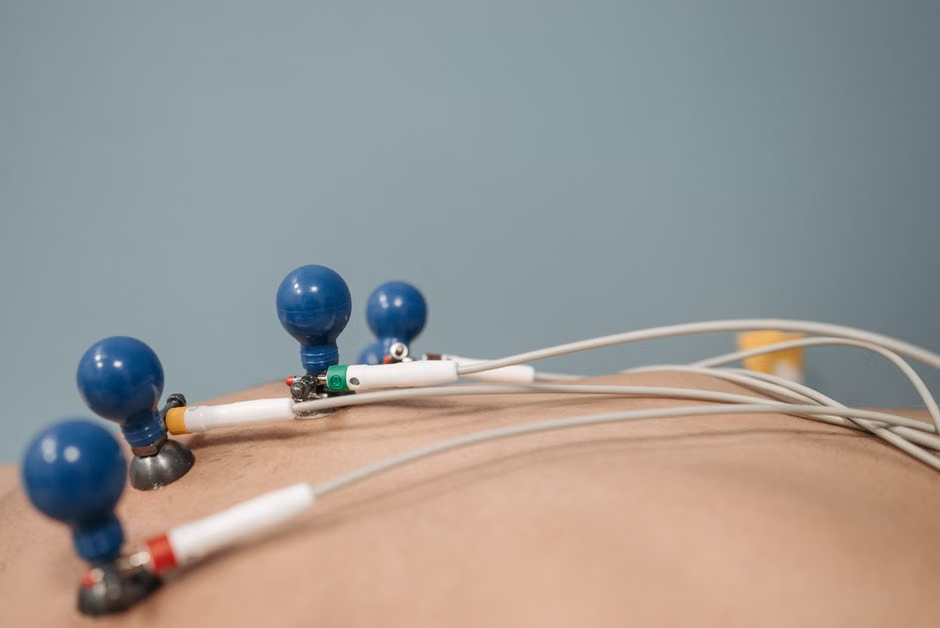
Nuclear cardiology sits at the intersection of cardiology and radiology, requiring dual-track awareness when planning CME. Physicians pursuing or maintaining CBNC credentials need content covering both clinical cardiology applications and nuclear imaging protocols. ASNC CME programs are the primary pathway for this subspecialty, but ACCME-accredited symposia that cover cardiac imaging count toward educational requirements as well.
Pediatric cardiology presents a distinct set of planning needs. Board certification in pediatric cardiology through the American Board of Pediatrics requires MOC activities that include pediatric-specific content, not just adult cardiology modules. Fetal echocardiography, congenital heart disease management, and pediatric arrhythmia protocols all fall within scope. We’ve developed symposia curriculum covering fetal echo and pediatric cardiac imaging that serve this subspecialty directly, which is a gap many general cardiology CME providers leave unaddressed.
Cardiology for Primary Care CME: Different Goals, Different Content
Primary care physicians and hospitalists pursuing cardiology CME have different objectives than cardiologists seeking MOC credits. The goal is clinical competency in managing common cardiovascular conditions within a general practice setting: hypertension, atrial fibrillation, heart failure monitoring, and appropriate referral thresholds. Not advanced procedural skill.
Programs designed for primary care should prioritize guideline-based management protocols, pharmacotherapy updates, and case-based learning that translates directly to the clinic. A well-trained primary care physician with solid cardiac auscultation skills catches what screening algorithms miss, and the CME that builds that skill matters as much as the equipment. When we design cardiology content for non-specialist audiences, we build it around real clinical decisions, not cardiology ASC-level procedures.
Will AI Replace Cardiologists?
No. AI will reshape how cardiologists work, not replace them. Current AI tools show genuine promise in ECG interpretation, echocardiogram image analysis, and cardiovascular risk stratification. But clinical judgment, procedural skill, patient communication, and ethical decision-making remain firmly in the domain of trained physicians.
What AI does change is which skills need sharpening. Mayo Clinic’s cardiovascular medicine program has noted that AI-assisted diagnostics improve outcomes when cardiologists understand the tool’s outputs and limitations rather than simply accepting them. That understanding requires education. CME programs integrating AI literacy into cardiac imaging and clinical decision support are becoming more relevant to recertification planning, and boards are beginning to reflect that shift.
“AI in cardiology is most powerful as an augmentation tool. Physicians who understand the underlying algorithms make better decisions than those who either disregard or uncritically accept AI outputs.”
Cardiologists who stay current through MOC and structured CME are better positioned to integrate new technologies safely and critically. The learning doesn’t stop. It changes shape.
Building a Practical Cardiology CME Plan
The most common mistake physicians make with recertification is waiting until year seven or eight of a ten-year cycle to take CME seriously. Here’s a structured approach that works:
- Map your certification calendar. List every active board certification you hold, the expiration date, and the MOC point requirement for each cycle.
- Identify subspecialty content gaps first. Pull your ABIM MOC transcript and find which content areas have the least activity. Target those with your first major CME investment.
- Book at least one major symposium per year. A live multi-day event delivers dense credit in a format that accelerates exam preparation. Don’t defer it for schedule convenience.
- Use on-demand content to fill targeted gaps. Multimedia programs and enduring online materials work well for topics you can study independently between events.
- Track credits in real time. ABIM’s online portal and ACCME’s PARS system update after each accredited activity. Log credits as you earn them, not at year-end.
- Revisit the plan annually. Subspecialty guidelines change. A cardiology CME plan built three years ago may not address what’s being tested today.
The overview below covers how structured cardiology CME programs are designed to align with MOC requirements and real clinical practice needs:
Cardiology recertification is a ten-year commitment that succeeds or fails based on how early you start planning. Whether your focus is pediatric cardiology, intervention cardiology, nuclear imaging, or general cardiovascular disease maintenance, the credit requirements are manageable with a clear annual structure and accredited educational partners who understand the demands on practicing physicians. Your patients benefit from every hour you invest in staying current. That’s not a slogan. It’s the whole point. Our team at Educational Symposia has been building those programs since 1975, and we’re here to make that investment as efficient and clinically meaningful as possible.